Table Of Content
For example, a the control arm of a randomised trial may also be used as a cohort study; and the baseline measures of a cohort study may be used as a cross-sectional study. As you can see, grounded theory is ideally suited to studies where the research aims involve theory generation, especially in under-researched areas. Keep in mind though that this type of research design can be quite time-intensive, given the need for multiple rounds of data collection and analysis. There are many different research design types when it comes to qualitative studies, but here we’ll narrow our focus to explore the “Big 4”.
Placebo
In terms of data collection, this could include interviews with staff and management, review of policy documents and financial statements, surveying customers, etc. One of the aspects that is often overlooked is the selection of cases and controls. It is important to select the cases and controls appropriately to obtain a meaningful and scientifically sound conclusion and this can be achieved by implementing matching. Every now and then during clinical practice, we come across a case that is atypical or ‘out of the norm’ type of clinical presentation. There are no inferences obtained and therefore cannot be generalized to the population which is a limitation. Most often than not, a series of case reports make a case series which is an atypical presentation found in a group of patients.
Exposure vs Outcome
Case‐control studies are also prone to biases such as recall bias, as the subjects are providing information based on their memory. Hence, the subjects with disease are likely to remember the presence of risk factors compared to the subjects without disease. In clinical research, our aim is to design a study which would be able to derive a valid and meaningful scientific conclusion using appropriate statistical methods. The conclusions derived from a research study can either improve health care or result in inadvertent harm to patients. Hence, this requires a well‐designed clinical research study that rests on a strong foundation of a detailed methodology and governed by ethical clinical principles. The purpose of this review is to provide the readers an overview of the basic study designs and its applicability in clinical research.

Research Design – Types, Methods and Examples
Examples of descriptive studies include a survey of dietary habits among pregnant women or a case series of patients with an unusual reaction to a drug. Cohort studies can be classified as prospective and retrospective.7 Prospective cohort studies follow subjects from presence of risk factors/exposure to development of disease/outcome. This could take up to years before development of disease/outcome, and therefore is time consuming and expensive. On the other hand, retrospective cohort studies identify a population with and without the risk factor/exposure based on past records and then assess if they had developed the disease/outcome at the time of study. Thus, the study design for prospective and retrospective cohort studies are similar as we are comparing populations with and without exposure/risk factor to development of outcome/disease.
Figures
The advantage with this methodology is that it enables comparability between experiment/intervention groups and thus makes result analysis more efficient. But, with this methodology the covariates will need to be measured and determined before the randomization process. The sample size will help determine the number of strata that would need to be chosen for a study. In simple randomization, the subjects are randomly allocated to experiment/intervention groups based on a constant probability.
Descriptive studies
This typically involves the researcher spending an extended period of time with the participants in their environment, carefully observing and taking field notes. This means that the researcher needs to assign participants to different groups or conditions in a way that each participant has an equal chance of being assigned to any group (note that this is not the same as random sampling). For example, withholding a potentially beneficial medical treatment from a control group may be considered unethical in certain situations. However, these differences will need to be accounted during analysis of results. In prospective studies, the outcome has not occurred at the time of initiation of the study.
Study designs, levels of evidence, and scientific bias
A practical consideration also motivates the restriction of many Cochrane reviews to randomized trials. The efforts of The Cochrane Collaboration to identify randomized trials have not been matched for the identification of other types of studies. Consequently, including studies other than randomized trials in a review may require additional efforts to identify studies and to keep the review up to date, and might increase the risk that the result of the review will be influenced by publication bias. This issue and other bias-related issues important to consider when defining types of studies (e.g. whether to restrict study eligibility on the basis of language or publication status) are discussed in detail in Chapter 10. Case control studies are the first articles published on new topics so they make up the base of the pyramid. As we progress up the pyramid, the studies become more evidence-based and less numerous.
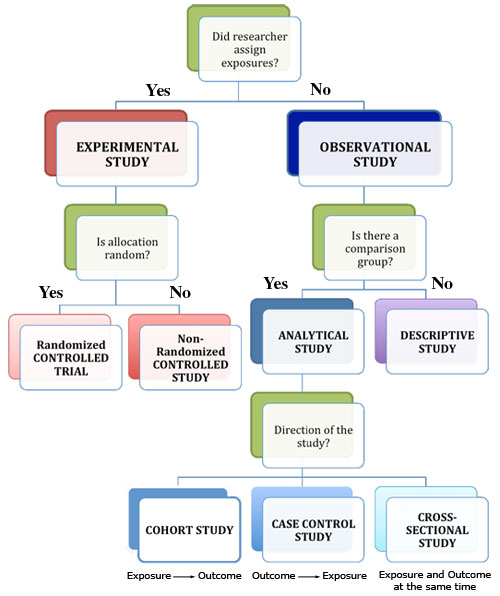
In these studies, the diagnosis, treatment and monitoring are performed exclusively according to medical practice and not according to a specified study protocol.[9] They are subclassified as per Figure 2. Retrospective Studies - Studies used to test etiologic hypotheses in which inferences about an exposure to putative causal factors are derived from data relating to characteristics of persons under study or to events or experiences in their past. The essential feature is that some of the persons under study have the disease or outcome of interest and their characteristics are compared with those of unaffected persons.
Realizing the Promise of Real-World Evidence - FDA.gov
Realizing the Promise of Real-World Evidence.
Posted: Thu, 21 Dec 2023 08:00:00 GMT [source]
That is, if there are two groups A and B, the subject has a 0.5 probability of being allocated to either group. This can be performed in multiple ways, and one of which being as simple as a ‘flip of a coin’ to using random tables or numbers.17 The advantage of using this methodology is that it eliminates selection bias. However, the disadvantage with this methodology is that an imbalance in the number allocated to each group as well as the prognostic factors between groups. Historically controlled studies can be considered as a subtype of non‐randomized clinical trial.
” – are difficult for respondents to answer and often lead to responses that are difficult to interpret. In this example, it would be more effective to ask two separate questions, one about domestic policy and another about foreign policy. The choice of words and phrases in a question is critical in expressing the meaning and intent of the question to the respondent and ensuring that all respondents interpret the question the same way. Even small wording differences can substantially affect the answers people provide.
Such studies controlled trials, particularly if randomised and blinded, have the potential to control for most of the biases that can occur in scientific studies but whether this actually occurs depends on the quality of the study design and implementation. Randomization is a well‐established methodology adopted in research to prevent bias due to subject selection, which may impact the result of the intervention/experiment being studied. It is one of the fundamental principles of an experimental study designs and ensures scientific validity. It provides a way to avoid predicting which subjects are assigned to a certain group and therefore, prevent bias on the final results due to subject selection. This also ensures comparability between groups as most baseline characteristics are similar prior to randomization and therefore helps to interpret the results regarding the intervention/experiment group without bias. A non‐randomized clinical trial involves an approach to selecting controls without randomization.
In this article, which is the first part of a series on "study designs," we provide an overview of research study designs and their classification. The following sections discuss the different types of analytical study designs. This study design compares groups of people, clustered on the basis of their geographical location.
For example, a researcher can follow a group of smokers and a group of nonsmokers to determine the incidence of lung cancer in each. In backward-direction studies, the researcher begins by determining whether the outcome is present (cases vs. noncases [also called controls]) and then traces the presence of prior exposure to a risk factor. For example, a researcher identifies a group of normal-weight babies and a group of low-birth weight babies and then asks the mothers about their dietary habits during the index pregnancy. The participants are randomly allocated to receive different interventions (no intervention, placebo, existing treatment, new treatment). This allows the investigators to exclude confounding factors such as selection bias and environmental exposure.
On questions where two versions are used, significant differences in the answers between the two forms tell us that the difference is a result of the way we worded the two versions. It is usually called a meta-analysis by the author or sponsoring body and should be differentiated from reviews of literature. Cross-Sectional Studies - Studies in which the presence or absence of disease or other health-related variables are determined in each member of the study population or in a representative sample at one particular time. This contrasts with LONGITUDINAL STUDIES which are followed over a period of time.
Clinicians are more familiar with interventional research, whereas epidemiologists usually perform observational research. With widespread internet use, phenomenally large number of publications, training and media resources are available but determining the quality of this literature is difficult for a busy physician. Abstracts are available freely on the internet, but full-text articles require a subscription.


No comments:
Post a Comment